A practical point of view on driving AI within Finance, written for the people who actually sign off on the numbers.
By Denton Cockburn, Chief AI Officer, Jarvis Consulting Group
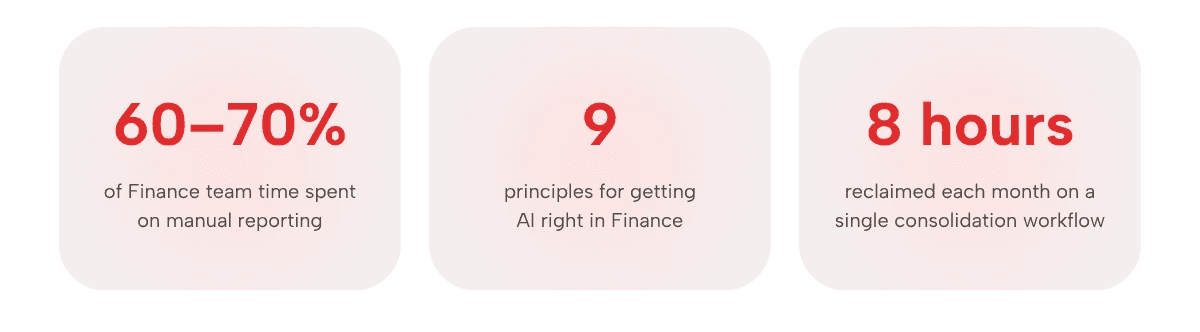
I have spent many hours sitting with finance leaders, and the same thing comes up in almost every conversation. The teams are talented, the processes are sound, and yet somewhere between 60 and 70 percent of the team's time still goes to assembling reports by hand. Collecting trial balances from systems that do not talk to each other. Linking spreadsheets together for the quarterly tax provision. Tracking intercompany eliminations across a stack of workbooks that only one person really understands. None of this is a skill problem. It is a process problem, and it happens to be exactly the kind of problem AI is good at removing.
I want to lay out how I actually think about this, because most of the AI conversation in finance right now is either breathless or fearful, and neither is much help when you are the person who signs off on the numbers.
AI does not replace the CFO's judgement. It clears away the work that gets in the way of exercising it.
Denton Cockburn, Chief AI Officer
That is the frame everything below follows from.
Where to begin
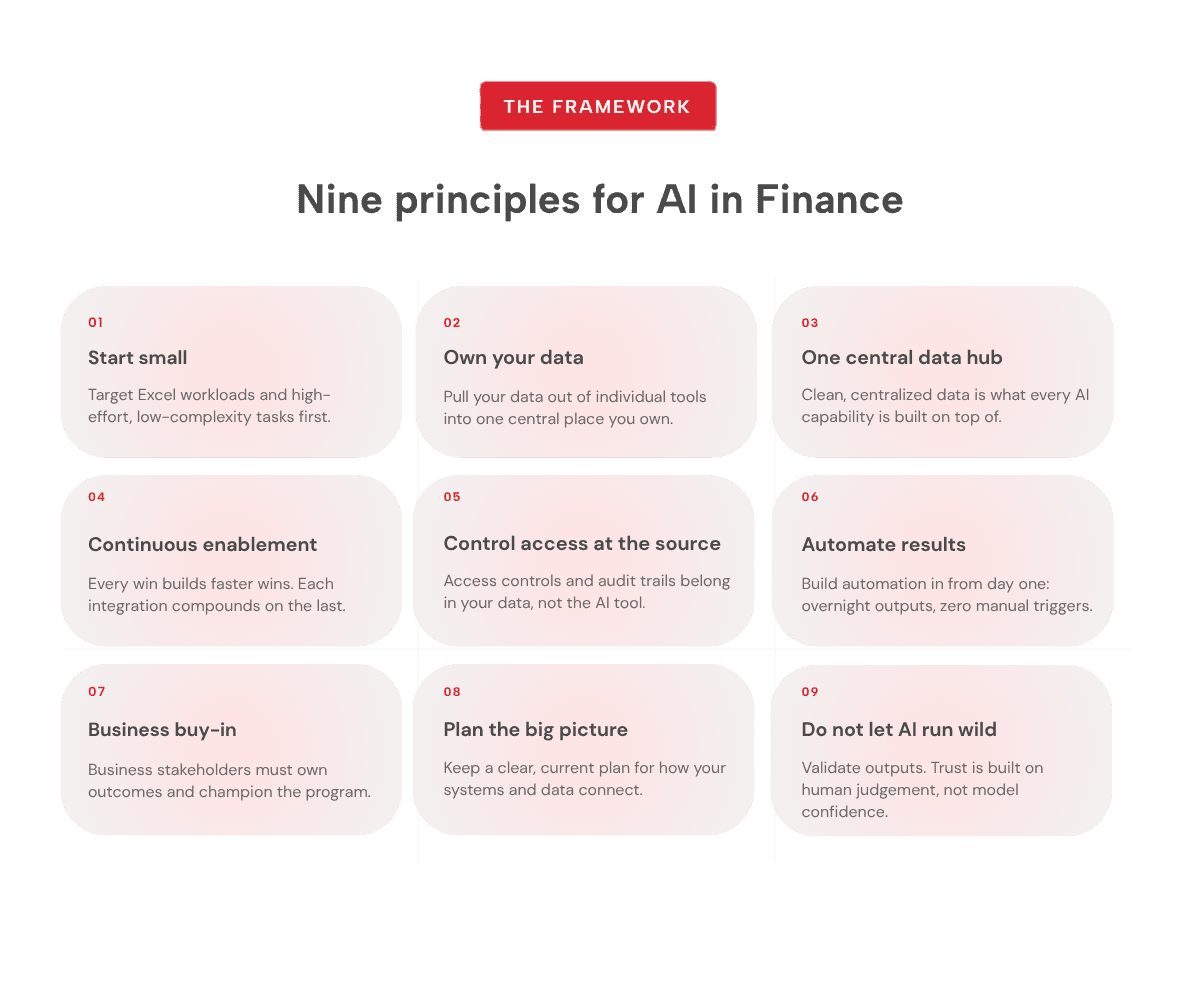
Start where the pain is
The temptation with AI is to reach for something ambitious. I would do the opposite. Pick the highest-effort, lowest-complexity work you have, and it is almost always hiding in a spreadsheet: consolidation assembly, tax provision workbooks, variance commentary. Prove the value there first, in a workflow your team already recognizes, and you earn the right to expand. Visible wins buy patience for everything that comes after.
The foundation
Own your data
The point I feel most strongly about is owning your data. Your accounting data probably lives across a general ledger or two, a consolidation tool, your tax platforms, HR, and a handful of third-party administrators. Each was built for its own purpose, and none of them can easily see the others. When your performance data sits inside a vendor's system, you inherit their reporting templates, their timelines, and their limits, rather than your own. A well-governed data hub that you own is the single most valuable AI asset a finance team can build. Without a common layer underneath, AI cannot reason across any of it, and a straightforward cross-system question, something like "what did we actually spend with our biggest supplier across the whole business last year," turns into a multi-day project.
Governance
Put your controls where the data lives
There is a governance question that finance teams rightly raise: once AI is touching sensitive data, how do we control who sees what, keep a clean audit trail, and meet our compliance obligations. The wrong answer is to trust the AI tool to police itself, because those limits can be worked around. The right answer is to enforce access at the source. One corporate login, fine-grained permissions on sensitive accounts, a tamper-proof record of who accessed what and when, and data labelled by sensitivity so the rules apply automatically. That way your governance holds no matter which AI tool you happen to be using this year or next.
Judgement
Keep humans in the loop
You also have to keep humans in the loop, without exception. AI is built to give you an answer even when the data is incomplete or the logic is uncertain. For anyone who presents numbers to auditors, boards, or investors, that is not acceptable without review. Build the checkpoints in from the start. Material outputs get human sign-off. AI-produced figures get cross-checked against source data before they reach anyone's desk. And every number should trace back to the transaction it came from, because a figure you cannot defend is a liability, not an asset.
Automation
Automate the end result
It is worth automating the end result, and building that in early. The tools exist today to run your processes overnight and have the output waiting before your team starts the day. Reconciliation summaries in the inbox each morning. Variance reports sent before the meeting. Month-end status that updates itself. A manual process is a process waiting to break, and adding automation later always costs more than building it in from day one.
Momentum
Let the work compound
Here is the part people tend to miss, which is that the work compounds. Each system you connect makes the next one cheaper and faster, because the clean data and the organizational confidence from the last win are already in place. Your tenth AI project should be easier than your first. I think of it as continuous enablement. Connect a system, deliver a concrete win, unlock questions that were impossible to ask before, and watch the team raise its own bar. Then repeat.
Ownership
The business has to lead
Finally, the business has to lead. AI investments fail when they are driven by IT and merely tolerated by the business. The office of the CFO needs to own the outcome, define the question, validate the answer, and champion the result. Success is not "we deployed an AI tool." It is "we closed three days faster and caught a provision error before it reached the auditors." Name a sponsor who owns that outcome, and celebrate the wins out loud, because that is how champions emerge.
In practice
What it looks like on the ground
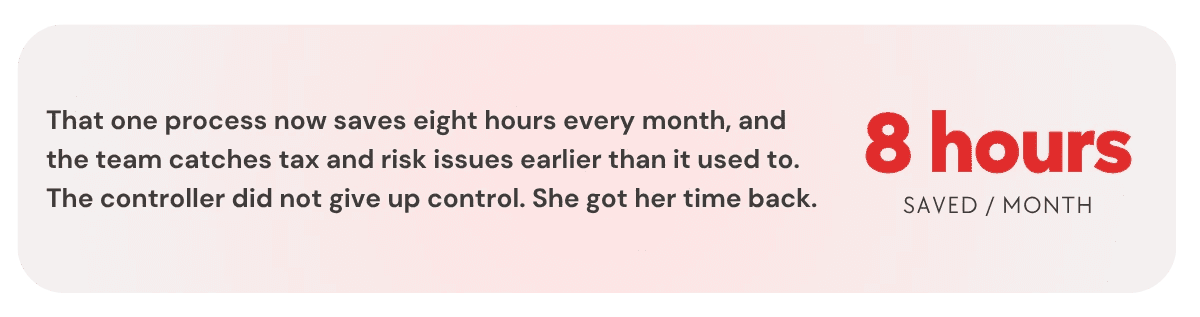
Let me make that concrete. One team I worked with ran a parent company and two subsidiaries across three legal entities and consolidated them by hand in Excel every month. We pulled the general ledgers, FX rates, and fee agreements into one place, let the AI layer combine the entities, draft the entries, and track the cross-border transactions, and left the controller firmly in control of review and sign-off.
The path forward
Start with one thing
None of this is a transformation project with a two-year timeline and a held breath at the end. It is a series of targeted decisions, each one delivering real value and building the foundation for the next. You do not need a complete map of every system before you begin. Start with one workflow, connect one source, and map the rest in parallel while that first win is already underway.
If you lead a finance team, the most useful question you can ask yourself this week is a small one. Which workflow costs my team the most time each month, and where do we lean on a single spreadsheet owner to hold it all together? That is where I would start. If you want to think it through together, my inbox is open.